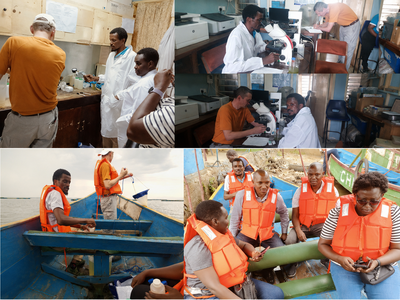
The recently completed KoEF project Sustainability of Flood Plains Supported Livelihoods in the Face of Climate Change in East Africa was jointly developed with The Technical University of Kenya, Kisii University, Chuka University, University of Rwanda, and University of Innsbruck. The researchers included: Evance Mbao, Martin Njogu, Moraa Gichana, Jane Oteki, Fabrice Musana, Marie Mutimawarigo, and Rainer Kurmayer.
The project partnership in Climate-Smart Agriculture for poverty reduction and food security in Rwanda and Kenya was based on the Sustainable Development Goals and aimed to
- establish a cooperation regional network between the countries of Rwanda, Kenya, and Austria,
- establish exchange networks and knowledge improvement, skills, and research experiences on climate-smart agriculture and water resources management approaches among partner institutions, and
- collaborate with small-scale farmers on skills and knowledge transfer in value chains for appropriate climate-smart agriculture systems and water resources management.
The study involved virtual and physical meetings, desktop surveys, and fieldwork in Kenya and Rwanda floodplains.
The limited literature and empirical data retrieved from desktop surveys and focus groups demonstrated that research and adoption of Climate Smart Agriculture (CSA) and Integrated Watershed Resources Management (IWRM) in Kenya and Rwanda floodplains are still relatively low as compared to the Global North, even though East Africa is highly prone to climate change dynamics because of the countries' dependence on rain-fed agriculture.
Increased adoption of advanced CSA and IWRM approaches can synergistically strengthen and promote natural systems such as ecosystems and social systems like livelihoods in enabling floodplain communities in Kenya and Rwanda to navigate climate change stresses and associated future uncertainties.
The actionable recommendations for policymakers, researchers, and practitioners include pushing for adoption and implementation of both CSA and IWRM in East Africa through rigorous research, actual field implementation, and subsequent publication of successful case studies in reputable journals to reduce overreliance on information from the Global North.